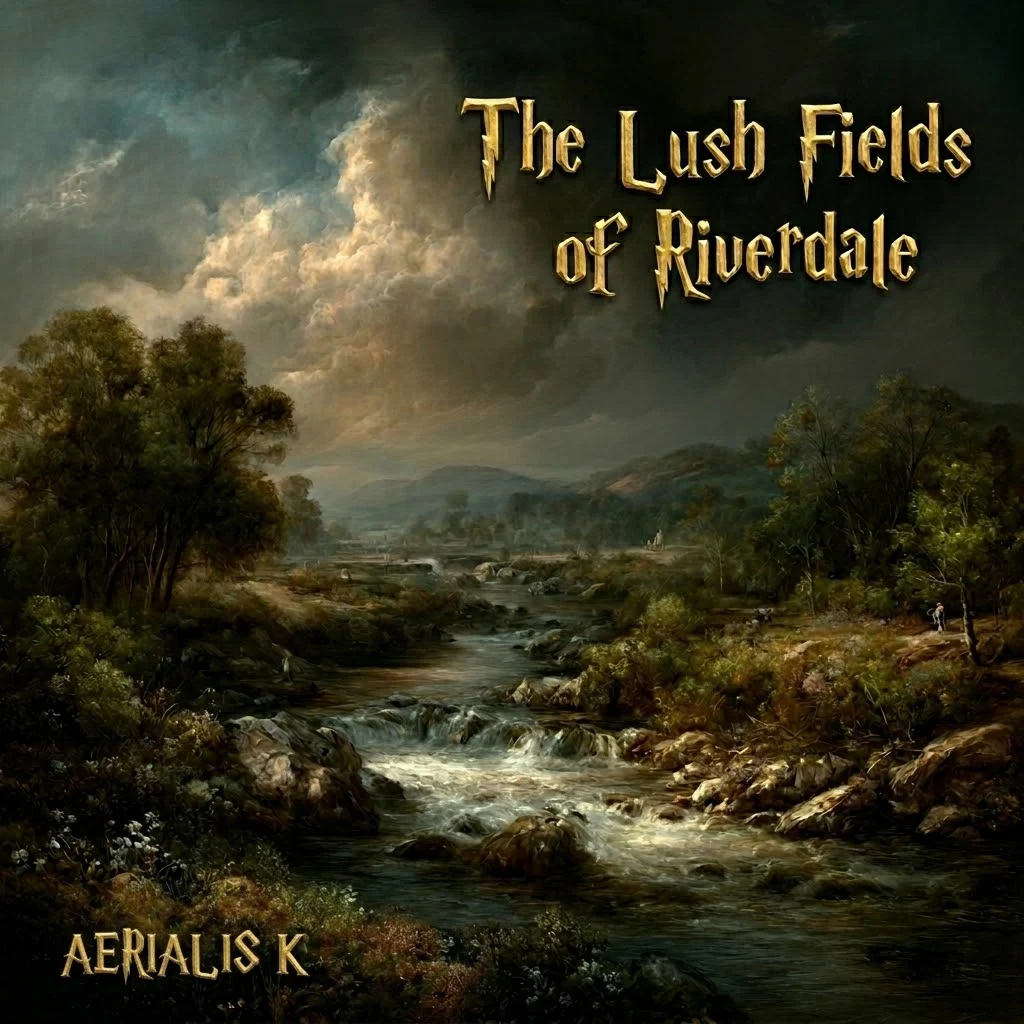
It is an ambitious exploration of the creative bridge between the melodic optimism of the British Invasion during the mid-1960s and the increasingly adventurous progressive rock movement that emerged toward the end of that decade and flourished in the early 1970s.
The result is an album that feels less like a collection of songs than a carefully curated landscape of memories, dreams, shifting identities and timeless places. Throughout its ten tracks, AERIALIS K embraces vintage instrumentation—Hammond organ, harpsichord, oboe, flute, strings, cello and shimmering psychedelic guitars—without allowing nostalgia to become mere pastiche. Instead, these sounds become the language through which deeply personal themes are explored.
A landscape of memory
The title track, “The Lush Fields of Riverdale,” immediately establishes the emotional geography of the album. Riverdale is more than a physical place; it becomes a symbol of childhood innocence, pastoral beauty and the bittersweet realization that some places can only truly exist in memory. The repeated images of blooming poppies, winding rivers and endless green fields create an idyllic world that feels almost mythological.
Rather than introducing conflict, the opening song gently invites the listener into a dreamlike state where remembrance becomes the central emotional force. It serves as the perfect gateway into an album preoccupied with time, identity and loss.
The passing of time
One of the album’s strongest thematic threads is the fleeting nature of life.
The beautifully understated “Vapor” distills this idea into remarkably few words. Using the image of an aging horse as a metaphor for youth slipping away, the repeated refrain—“Such vapor is youth”—becomes almost hypnotic. Its simplicity gives it surprising emotional weight, echoing the philosophical minimalism found in late psychedelic songwriting.
Time itself becomes almost elastic in “Where the Time (Slips Slow),” arguably one of the album’s lyrical highlights. Here memories are nonlinear, love exists outside chronology, and reality bends into dream logic. The imagery—unfinished letters, unwritten notes, glowing clocks and folding skies—places the song somewhere between surreal poetry and progressive rock storytelling.
Rather than mourning the passage of time, these songs suggest that memory quietly reshapes reality instead of preserving it.
Duality and self-reflection
Perhaps the emotional centerpiece of the album is “Two Suns.”
Built around one of the album’s strongest metaphors, the song explores the coexistence of conflicting identities. Major and minor keys, reflected skies, tides and mirrored personalities create an elegant meditation on accepting one’s contradictions rather than resolving them.
The conversational bridge (“Who gets to steer when the wheel is round?”) recalls the introspective ambitions that progressive rock increasingly embraced during the late sixties while retaining the melodic accessibility of classic British pop.
It is one of the album’s most sophisticated compositions both lyrically and musically.
Love, absence and longing
Several songs revolve around emotional absence without descending into melodrama.
“The One That Got Away” revisits lost love through concise songwriting reminiscent of classic British guitar pop, while “Into the Unknown” transforms uncertainty into an invitation rather than a fear. Its gradual movement from hesitation toward surrender mirrors the album’s recurring idea that growth often requires stepping beyond certainty.
Meanwhile, “Beneath the Weeping Willows,” the nearly ten-minute closing epic, expands those emotional themes into something almost spiritual. Ghosts, rivers, September fires and weeping trees combine into an elegiac finale that feels equally inspired by progressive rock’s long-form storytelling and traditional folk ballad imagery.
Its extended instrumental passages never feel indulgent; instead they allow the atmosphere to breathe, giving the album a powerful and satisfying conclusion.
Nature as emotional language
Throughout the record, nature is never merely decorative.
Fields, rivers, forests, dew, oceans, tides, trees, flowers and changing skies become emotional states rather than scenery.
Even “Walking Barefoot”, perhaps the album’s brightest and most immediately joyful moment, celebrates ordinary earthly existence with surprising philosophical depth. Rather than longing for heaven, the narrator chooses life’s simple pleasures—a morning coffee, wet grass beneath bare feet and companionship.
The environmental imagery becomes darker in “The Emerald Forest”, featuring Aerialyn, where lush greenery masks ecological decay. What first appears enchanted gradually reveals itself as artificial, poisoned and frozen in time. It is one of the album’s most unsettling moments and introduces a subtle ecological dimension without becoming overtly political.
The sound
Musically, The Lush Fields of Riverdale succeeds remarkably well in its stated ambition.
Nearly every track draws inspiration from the rich vocabulary of British music between 1965 and 1973. Listeners will recognize echoes of psychedelic pop, British beat music, baroque pop, early progressive rock and pastoral psychedelia. Hammond organs swirl beneath shimmering guitars; oboes and flutes colour arrangements rarely heard in contemporary productions; harpsichords, strings and occasional brass expand the sonic palette without overwhelming the songs.
Tempo choices generally remain moderate, allowing atmosphere and melody to take precedence over technical display. Even the more progressive moments never lose sight of memorable choruses—a balance many modern retro-inspired artists fail to achieve.
The production aesthetic intentionally avoids excessive polish. Instead, it favors warmth, spacious arrangements and organic instrumentation that reinforce the illusion of rediscovered recordings from another era while still sounding unmistakably modern in composition.
The album’s central thread
Although each song stands comfortably on its own, the album’s emotional narrative gradually becomes clear.
This is an album about looking backward without becoming trapped in the past.
Its characters revisit childhood landscapes, lost lovers, fading youth, uncertain futures, fractured identities and memories that refuse to disappear. Rivers continually flow through the songs, forests conceal hidden truths, fields preserve forgotten innocence, and time itself bends according to emotion rather than chronology.
The recurring landscapes become metaphors for the human mind: beautiful, mysterious, imperfect and constantly changing.
Rather than offering simple nostalgia, AERIALIS K suggests that memory is creative. We do not revisit the past—we quietly reinvent it every time we remember.
Final verdict
With The Lush Fields of Riverdale, AERIALIS K has created more than an affectionate tribute to Britain’s musical heritage. It is a thoughtful exploration of the evolutionary path from British Invasion songwriting toward the richer textures and philosophical ambitions of progressive rock.
Its greatest strength lies not simply in recreating vintage sounds, but in understanding why those sounds mattered: they provided space for imagination, introspection and emotional storytelling.
Listeners seeking contemporary pop may find the album’s deliberate pacing and atmospheric arrangements unconventional. Those willing to immerse themselves in its pastoral imagery, psychedelic textures and reflective lyricism, however, will discover an album rich in mood, symbolism and quiet beauty.
Rather than chasing nostalgia, The Lush Fields of Riverdale reminds us that some musical landscapes remain timeless—not because they belong to the past, but because they continue to speak to the present.
Rating: 8.8/10
A beautifully crafted psychedelic journey that successfully connects two defining eras of British rock while establishing a distinctive poetic voice of its own.