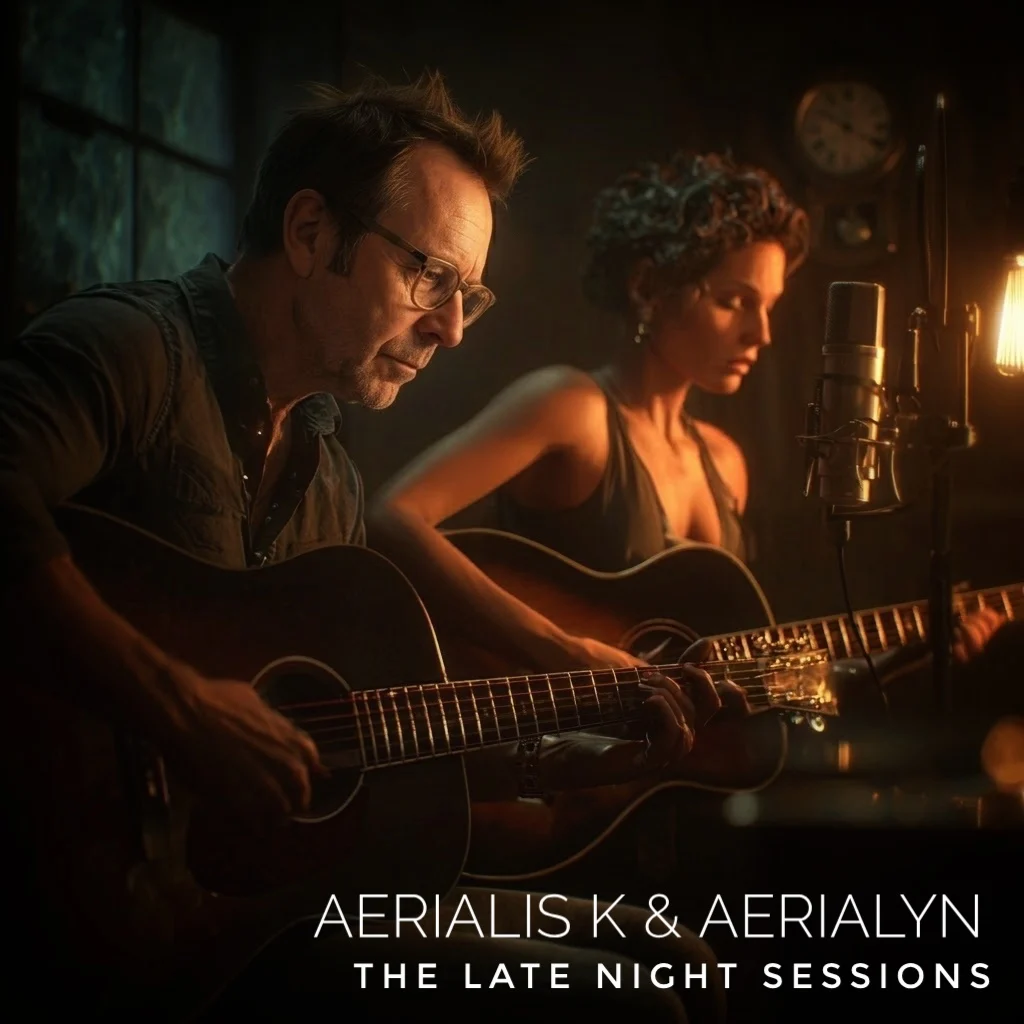
Some albums are meticulously crafted over months or years. Others simply… happen. The Late Night Sessions belongs firmly in the latter category—a project born from insomnia, creativity, and the kind of unfiltered collaboration that can’t be planned. What AERIALIS K and Aerialyn have created here is not just a collection of songs, but a snapshot of a moment where instinct took the lead—and, impressively, didn’t lose its way.
At its core, the album is grounded in Americana. That foundation is crucial. Without it, the stylistic detours into English folk traditions, folk rock textures, trip hop atmospheres, and even hints of pure pop could easily have felt disjointed. Instead, the record moves like a steady current beneath shifting skies—consistent in tone, yet varied in color.
Opening with The More I Get the Less I Want, the album sets a thematic tone of contradiction and quiet dissatisfaction. The repetition in the chorus mirrors the cyclical nature of desire itself, while the lyrics expose a subtle emptiness beneath material abundance. It’s minimal, almost hypnotic, and establishes the introspective lens that carries through much of the album.
Meant to Last leans more toward pop sensibility without abandoning the acoustic backbone. It captures the fragile intensity of short-lived relationships with a directness that feels both youthful and reflective. The line between nostalgia and resignation is thin here—and intentionally so.
One of the album’s standout emotional moments comes with For Us to Stay Young. What begins as a warm recollection of summer freedom gradually reveals an undercurrent of existential anxiety. The juxtaposition of fleeting joy and inevitable mortality gives the track a weight that lingers long after it ends. It’s here that the blend of airy production and grounded songwriting works particularly well.
A Very Long Time strips things down further, focusing on the quiet strangeness of distance and change. Its simplicity is its strength—repetition becomes reflection, and the understated delivery allows the listener to fill in the emotional gaps.
Darker tones emerge in Looking into the Fire, where obsession and regret take center stage. The imagery is vivid but not overworked, and the restrained arrangement keeps the focus on the emotional tension rather than dramatic excess.
What Happened to You introduces a slightly more experimental edge, with a recurring dream motif that adds a layer of psychological unease. It feels like a bridge between the album’s acoustic roots and its more atmospheric ambitions.
By the time we reach That’s Just a Waste of Time, the album shifts into a more detached perspective on relationships—less longing, more acceptance. The message is clear: not everything is meant to be fixed or saved.
Closing track Cardinal Sin ties the threads together with a raw, almost confessional tone. It confronts attraction to chaos and emotional self-sabotage, ending the album on a note that feels unresolved—but intentionally so. It doesn’t offer closure, because the album itself isn’t about resolution. It’s about capturing a state of mind.
What makes The Late Night Sessions particularly compelling is how cohesive it feels despite its spontaneous origin. The Americana base acts as an anchor, allowing the album to explore without drifting. The production remains understated but purposeful, letting the songwriting take center stage.
In the end, this is a short album—but not a slight one. It feels complete, not because it answers everything, but because it doesn’t try to. It captures something fleeting and turns it into something lasting. And that, perhaps, is the real achievement here.