Some albums feel designed for streaming playlists. Others feel designed for moments.
Aerialyn’s Cowboys and a Campfire belongs firmly in the latter category.
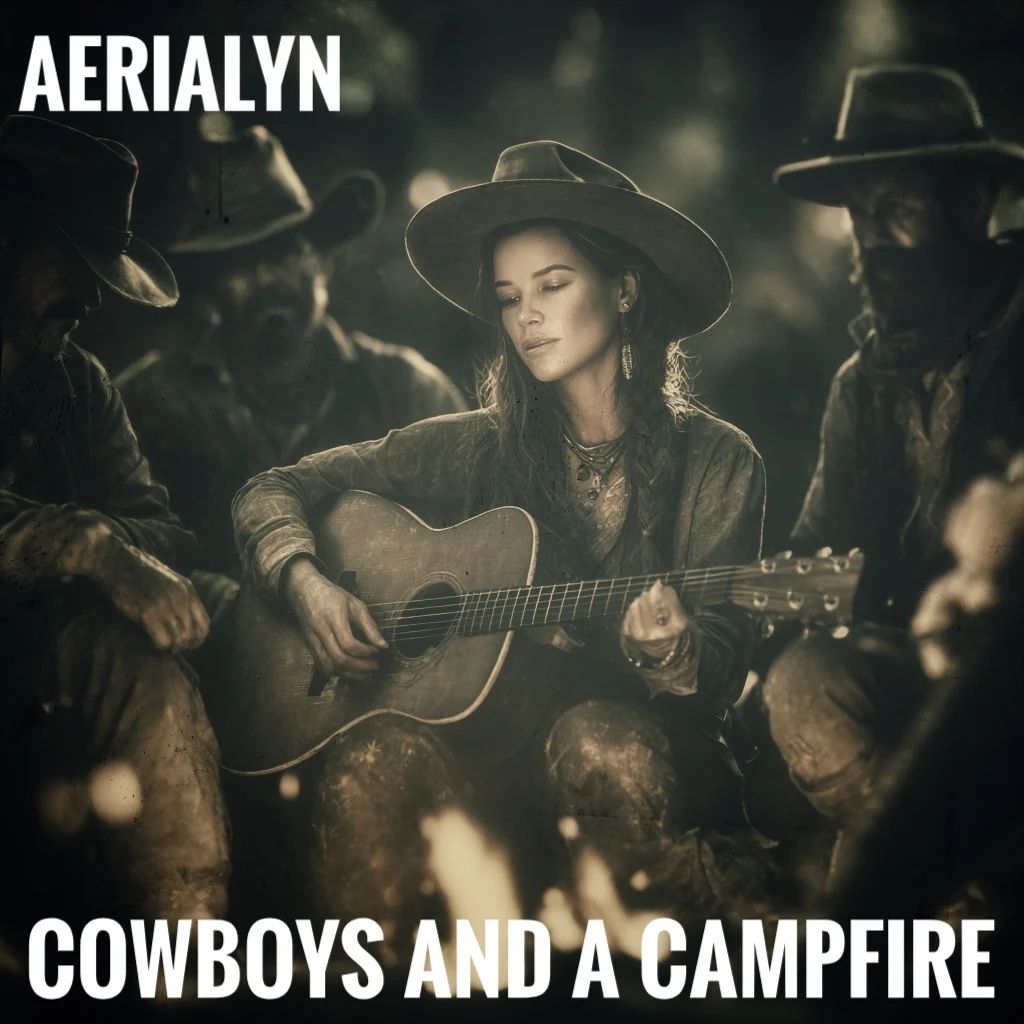
Following the nocturnal atmosphere of The Late Night Sessions, one can easily imagine Aerialyn walking away from the city lights, guitar in hand, settling beside a campfire somewhere on an endless prairie at sunset. Before long, weary cowboys gather around the flames, boots dusty from the day’s work, listening quietly as the stars emerge overhead. Whether real or imagined, that scene perfectly captures the spirit of this remarkable album.
At its core, Cowboys and a Campfire is a collection of songs about human connection and isolation, memory and longing, hope and resignation. It is steeped in the traditions of Americana, folk, country, and singer-songwriter music, yet never feels trapped by nostalgia. Instead, Aerialyn uses familiar sounds—Rhodes piano, bottleneck dobro, fingerpicked banjo, Hammond organ, mandolin, and sparse acoustic instrumentation—to create something that feels both timeless and surprisingly fresh.
The title track, “Cowboys and a Campfire,” serves as the album’s mission statement. Its deceptively simple lyrics paint an idyllic vision of companionship and contentment, where heaven isn’t a distant promise but a moment shared beneath the stars. The repeated refrain could easily become sentimental in lesser hands, but Aerialyn’s understated delivery transforms it into something quietly profound. The song understands that happiness often resides in ordinary moments.
That sense of emotional restraint runs throughout the album.
“All Alone in the Crowd” is one of the record’s most affecting performances, built around themes of invisibility and emotional exhaustion. Its recurring chorus captures a universal feeling of loneliness despite physical proximity to others. The sparse arrangement allows the vulnerability of the lyric to take center stage, making the song feel less like a performance and more like a confession.
Musically, the album demonstrates impressive range while maintaining a coherent identity. “Welcome to the Badlands” introduces a darker, more cinematic atmosphere. The Hammond organ adds texture and tension, while the imagery evokes a mythological American West populated by outlaws, wanderers, and restless souls. The song feels equally indebted to classic country storytelling and modern alternative Americana.
“Ice Cream Man” provides one of the album’s most charming surprises. Stripped-down contemporary folk collides with subtle spaghetti-western influences to create a song that is playful, romantic, and disarmingly sincere. What could have been a novelty track instead becomes a tender portrait of awkward attraction and everyday longing. The imagery of melting ice cream mirrors the narrator’s emotional vulnerability with delightful simplicity.
The album repeatedly finds strength in small details.
“Please Light that Candle” uses a single recurring image—the candle—as a metaphor for reconciliation, forgiveness, and the fragile persistence of hope. Meanwhile, “The Second Bottom Drawer” may be the record’s finest songwriting achievement. The central image of preserving a drawer for a lost love is beautifully understated, allowing an ordinary household object to carry enormous emotional weight. It recalls the best traditions of country songwriting, where profound emotions are often expressed through concrete, everyday imagery.
The middle section of the album expands its thematic scope. “Gather ’round Ye Comrades” feels almost like a folk standard rediscovered from another era. Combining communal singalong energy with apocalyptic undertones, it calls listeners together in the face of uncertainty while delivering a pointed rejection of tyranny. The song’s language evokes centuries-old ballad traditions while remaining relevant to contemporary anxieties.
Similarly, “No More Vigilantes” channels Southern Gothic and swampy Americana influences into a powerful statement about justice, power, and accountability. The combination of mandolin, slide dobro, Hammond organ, and forceful lyrical imagery gives the song a sense of urgency that stands out among the album’s more introspective moments.
If there is a recurring theme throughout Cowboys and a Campfire, it is the tension between connection and separation.
“The Saddest Love Song in the World” explores the aftermath of a toxic relationship through elegantly repetitive lyrical structures. The repeated inversions of love, hate, guilt, and regret create a cycle from which neither party can escape. Its melancholy folk-pop arrangement provides one of the album’s most accessible and emotionally direct moments.
“Howling at the Moon” returns to classic country territory with striking confidence. Built upon one of country music’s oldest themes—the lonely heart left behind—it could easily have become cliché. Instead, Aerialyn’s sincerity elevates the material. The song feels less like an imitation of traditional country and more like a continuation of its enduring emotional vocabulary.
The album closes with “Is This All There Is?”, perhaps its most philosophically ambitious song. Beginning as an examination of disappointment, aging, and unrealized expectations, it gradually transforms into something resembling existential acceptance. The song’s central question is never fully answered, but that ambiguity becomes its greatest strength. Rather than offering easy solutions, it invites listeners to confront the question themselves.
What makes Cowboys and a Campfire particularly successful is its understanding of atmosphere. Many contemporary albums mistake minimalism for emptiness. Aerialyn understands that silence, space, and restraint can be powerful musical tools. The sparse arrangements never feel unfinished; instead, they create room for reflection, allowing every instrument and every lyric to breathe.
There are echoes of alternative Americana artists, traditional country storytellers, Appalachian folk traditions, British Invasion songwriting, and contemporary singer-songwriters throughout the record. Yet the album never feels derivative. Its influences are absorbed into a distinct artistic voice that values authenticity over innovation for its own sake.
In an era dominated by maximalist production and constant stimulation, Cowboys and a Campfire offers something increasingly rare: patience. It trusts listeners to sit with uncertainty, sadness, memory, and beauty. It asks them not to consume the music quickly but to inhabit it.
The result is an album that feels like a long conversation beside a fading campfire—sometimes funny, sometimes sad, occasionally profound, and always human.
Aerialyn’s Cowboys and a Campfire is a beautifully crafted collection of atmospheric Americana and thoughtful songwriting that balances traditional roots with contemporary sensibilities. It is an album of quiet power, rewarding listeners willing to slow down and stay awhile by the fire.